

Visit Us At Texas Linux Fest 2026 To Grab Your Own TXLF Keychain Phone Stand!
Last year, Brian and I ran the Butter, What?! booth at Texas Linux Fest. We had a good time. I remember so many fun conversations with more than one hundred people who stopped by to check out what we were up to. I remember lots of faces. I remember lots of stories. I remember a few names. What don’t I remember? I have absolutely no idea which faces went with which stories or which names!
I hope you don’t miss out this year. On the second day last year, several people walked up to our table and literally said that they heard this was the coolest table at the event. I don’t know if this is true, but is it likely that three or more people could be wrong?!
We brought my little Bambu A1 Mini 3D printer with us last year, and we had it printing little USB adapter holders. It was a fun little print, and we gave a few away, but I didn’t put a ton of thought into it. Sure, it is a handy way to carry fewer USB cables, and it helped me pare down to only USB-C to USB-C cables in my bag, but plugging into older hardware isn’t a problem shared by many people.
This year, I want to print something more interesting. Something more people might find useful. Something that might help stir up some conversation.
- We Had A Booth At Texas Linux Fest 2025!
- Texas Linux Fest, After The Fact
- The Bambu A1 - Do I Regret Buying an A1 Mini a Month Ago?
- DIY NAS: Texas Linux Fest 2026
Why a phone stand?!
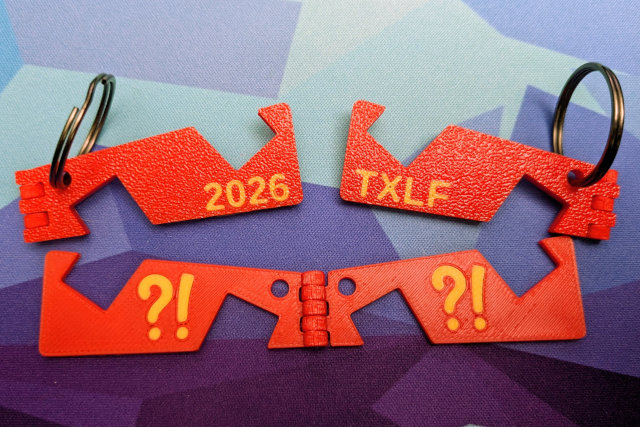
First of all, phone stands are useful. Stuck somewhere and want to watch some YouTube videos? There’s a little folding stand on your keychain ready to help you out. Need to keep an eye on your phone at the office? Prop it up near your monitor. Do you want to play 15 minutes of video games with your tiny 8BitDo controller? No problem.
We’ve got something useful, but why specifically a folding phone stand? It is the print-in-place hinge. Articulating 3D prints are more fun to talk about. Hinges that print fully assembled are even more fun.
Some people won’t care. Some people will already know this is possible. Another group of people will find this fascinating, and talking about how this is possible with 3D printing will be fun!
Why design a phone stand from scratch?
I almost didn’t! There are dozens of similar designs on MakerWorld and Printables. My plan was to find the most interesting model with an open-source license, engrave “TXLF2026” on one side, and call it a day.
That doesn’t give us anything to talk about. I decided to task my Pi coding agent and some open-weight models with designing a parametric OpenSCAD keychain phone stand for me.
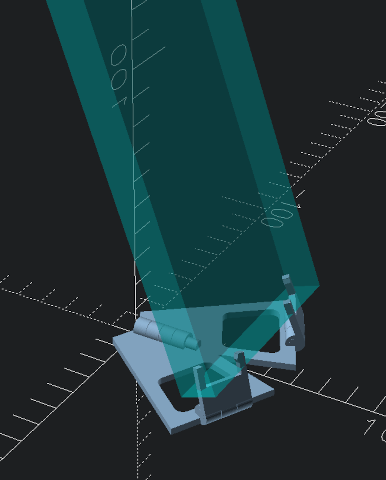
What models did I use? Which ones had trouble? Which succeeded? How much did it cost? What did the mistakes look like? Would Claude Code have done a better job?
There are SO MANY things to talk about, and I’m assuming that the people who visit our booth at Texas Linux Fest will either already be using coding harnesses for programming and sysadmin work or be thinking about it.
What model designed the keychain? How much did it cost?!
I don’t want to give away too much detail here, because I want to talk to you about it on November 6 and 7! I can definitely give you the highlights.
I gave the models screenshots from one or two existing phone stands on MakerWorld. I explained what I wanted as best I could in English. I can tell you that even the most capable LLMs have trouble here. Heck, I have trouble when talking about 3D models in real life. Which way is up? When you want to say a hinge folds, which axis does it fold on? How does the phone slot into the stand? If you are printing flat, but the part is in a different orientation when in use, how do you explain that? Ugh!
I tried my most powerful cheap model, which was DeepSeek V4 Flash 0831 at the time. We had serious communications issues. When DeepSeek Flash fails, I usually reach for GLM-5.3, which is what I did in this case as well. We had the same communications problems.
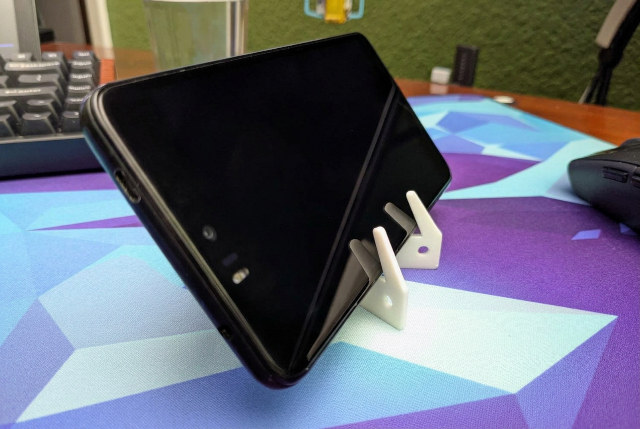
That’s when I moved up to Kimi K3. A friend in our Discord community mentioned that models with vision capabilities tend to be better at 3D modeling. GLM-5.3 isn’t that far off from Kimi K3, but K3 is a vision model. I think he is correct. Kimi K3 may have cost a lot more, but it seemed to do a much better job understanding my vague descriptions.
I spent a total of $13.23. A dollar or two went to the false starts with DeepSeek Flash (average of $0.06 per million tokens) and GLM-5.3 ($0.33/m). The bulk of this was Kimi K3 ($0.75/m) doing the real work, but I did some of the simpler tuning towards the end with GLM-5.3-Flash ($0.04/m).
Most of the tokens were from my Charm Hyper plan, which was stupidly cheap that month. The $20 subscription was buying me $12.50 in tokens every single day, so I barely used up 1/30 of my $20 plan on this project.
- Is The $6 Z.ai Coding Plan a No-Brainer?
- Contemplating Local LLMs vs. OpenRouter and Trying Out Z.ai With GLM-4.6 and OpenCode
- Should You Run A Large Language Model On An Intel N100 Mini PC?
We aren’t just bringing phone stands!
Brian updated his 3D-printed Texas Linux Fest coasters for 2026, and he’s printed a large stack to give away. The 2026 version wears an AI-generated take on the Texas Linux Fest logo–he handed the logo to Z.ai’s GLM-5.3 and asked for something that would actually print, which is far less work than the hand-cleaning and 3MF-wrangling he did for last year’s version.
Here’s what Brian’s bringing:
- A big stack of coasters, free for the taking
- His DIY NAS: Texas Linux Fest 2026, which he’s giving away in a raffle at the end of the conference
- Plenty of opinions about 3D-printed computer cases, because he just assembled one
The main event is the DIY NAS: Texas Linux Fest 2026. Brian built it around makerunit’s 12-bay ATX NAS case, printed it himself, and customized it with the Texas Linux Fest logo. Inside: an Intel N150, 32GB of DDR5, dual 10GbE, and twelve 3.5” drive bays. The whole build came to just under $960 in new parts, including a power supply he’d been saving in his closet for six years.
The case is big, but all of those parts fit and can be printed on my diminutive Bambu A1 Mini. A 12-bay, full-ATX NAS case off a printer with a 180mm build volume. That alone is worth the walk to our booth.
Brian wrote up the whole build and the full parts list. Go read his post, then come look at the real thing and tell him what you would have done differently.
So come see us on November 6 and 7!
Brian and I will be at Texas Linux Fest 2026 on November 6 and 7. Come find our booth and grab a keychain phone stand while we still have them, pick up one of Brian’s coasters, and get a look at the 12-bay case in person before it goes home with someone–maybe that someone will be you?! You don’t need an excuse to stop by, but if you want a shot at the case, you will have to come ask us how to get in on that!
I am also looking forward to arguing about model pricing with you. Is Kimi K3 (now K3.1-pro?!) worth almost twenty times what GLM-5.3-Flash costs? Would Claude Code have gotten it right on the first try? Have you had more success 3D modeling with LLMs than I have? Those are the conversations I am looking forward to most.
If you can’t make it to Austin, or you stopped by and want to keep talking, join our Discord community. We have channels for coding agents, 3D printing, and homelabs, along with a wide range of other geeky topics. Even if you can’t make it to Texas Linux Fest, drop in and say hello!